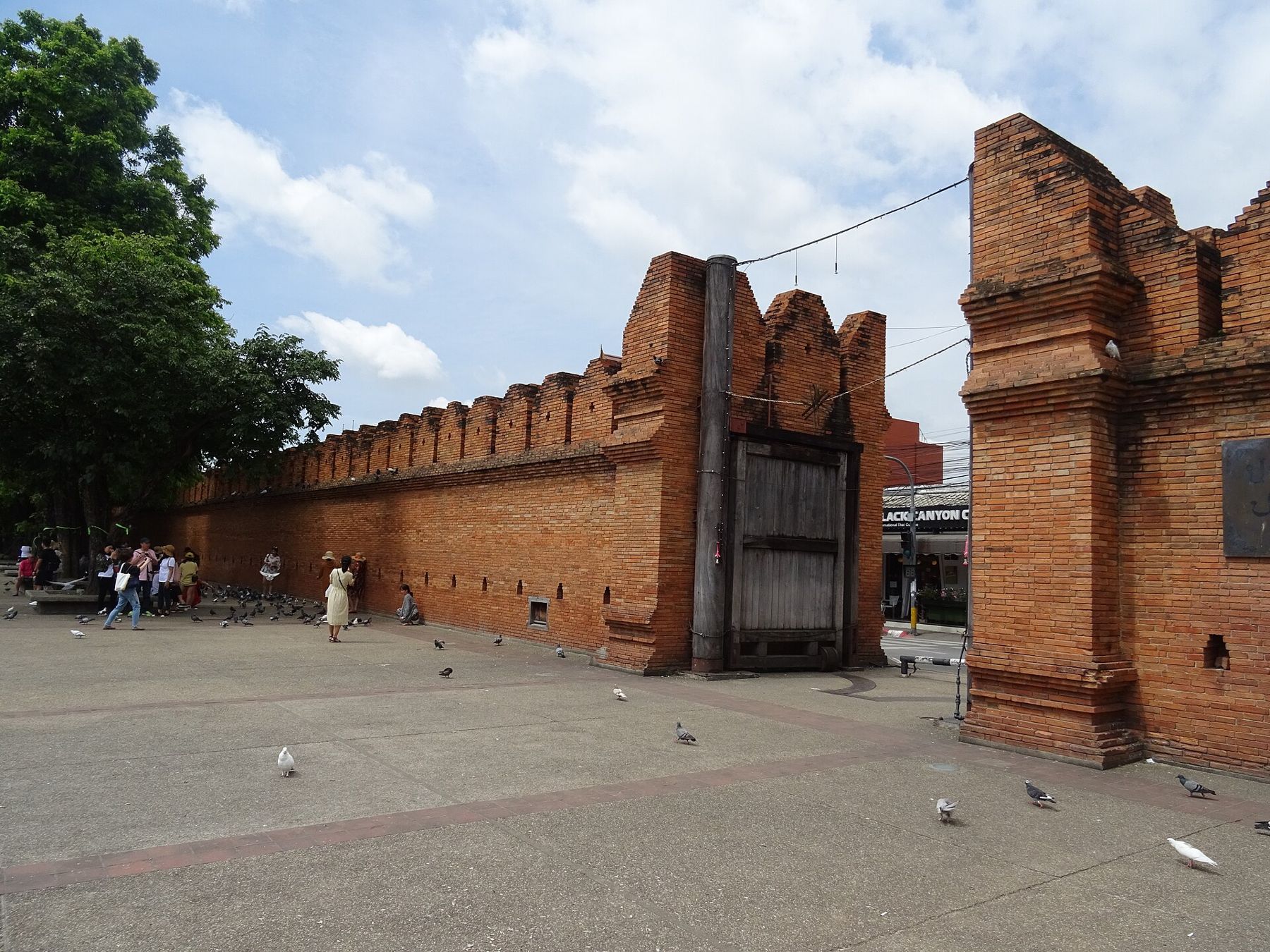
Chiang Mai was founded in the late thirteenth century as the capital of the Lanna kingdom, which ruled much of what is now northern Thailand. Its founders laid out the city as a square, surrounded by a moat and brick walls, with a gate in the middle of each side and bastions at the corners. More than seven hundred years later, the moat still holds water, sections of the walls and all the main gates still stand, and the square remains the city's historic heart.
Inside the moat, the old city is a grid of lanes and roads holding dozens of temples, from great complexes to tiny neighbourhood shrines. It is about a mile and a half on each side, which makes it easy to walk in a morning.
Tha Phae Gate
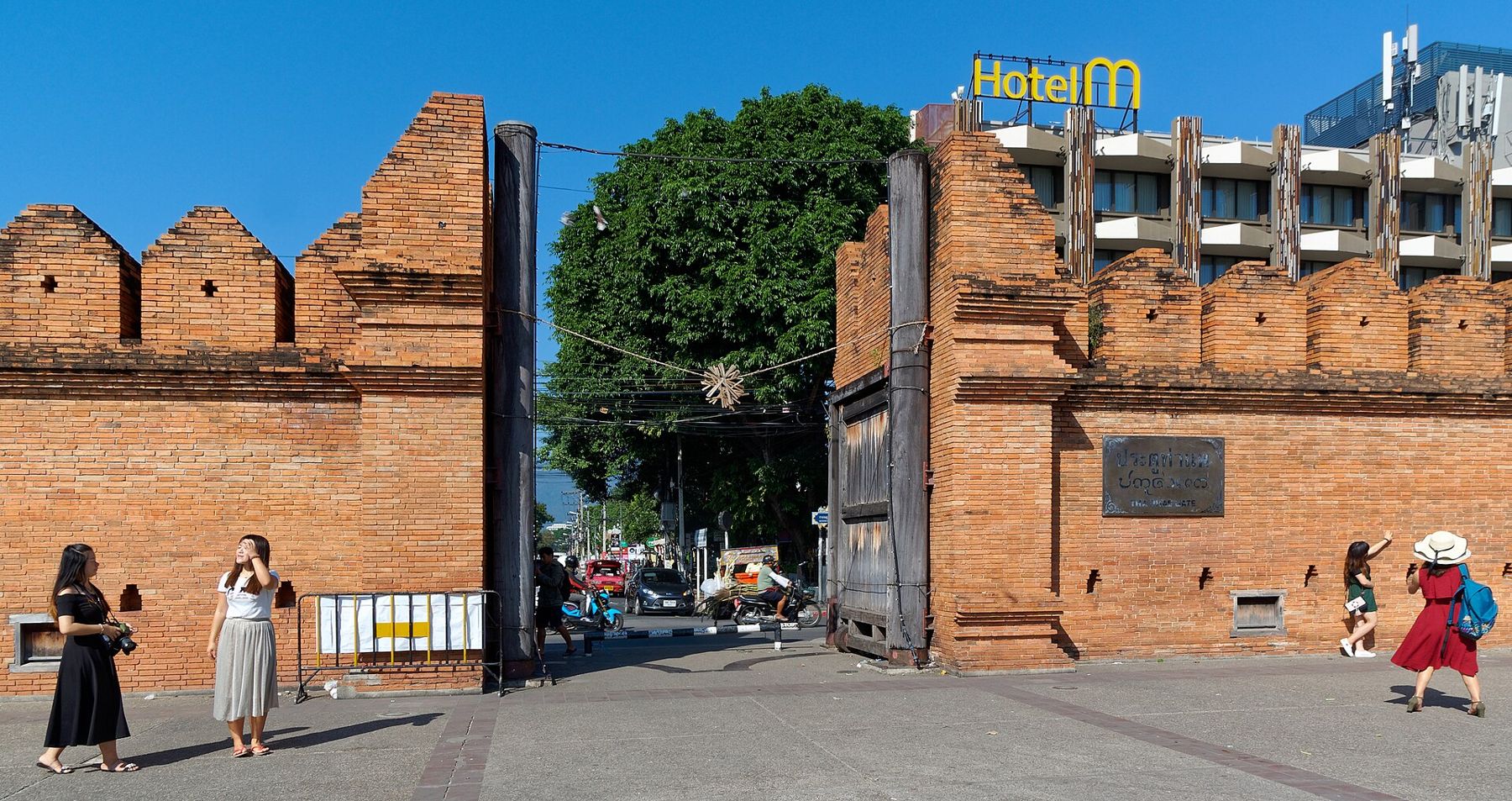
The walk starts at Tha Phae Gate, on the eastern side of the square. It is the best-known of the gates, with a stretch of restored wall on each side and an open square in front, often busy with pigeons, tourists and events. From the gate, Ratchadamnoen Road runs straight west through the old city, linking several of the major temples. It is the backbone of this walk.
The walls of the old city are made of brick, and many sections were rebuilt in the twentieth century. The moat is lined with trees and fountains, and roads run along both sides of it, carrying much of the city's traffic.
i
Wat Chedi Luang
Walking west along Ratchadamnoen Road and turning south, you reach Wat Chedi Luang, home to the largest structure in the old city. Its great brick chedi was built in the fourteenth and fifteenth centuries, and it once rose much higher than it does today. An earthquake in the sixteenth century brought down the top, leaving a massive ruined base with elephant sculptures on its sides and naga serpents guarding its stairs. For a time it housed the Emerald Buddha, now in Bangkok.
The temple grounds also contain the city pillar shrine, a sacred site believed to protect Chiang Mai. By tradition, women are not allowed inside the pillar shrine. Wat Chedi Luang is also known for its monk chats, informal conversations where visitors can talk with novice monks about Buddhism and daily life in the temple. Check times locally.
Wat Phra Singh
At the western end of Ratchadamnoen Road stands Wat Phra Singh, one of the most important temples in northern Thailand. It houses the Phra Singh Buddha image, which is carried through the streets during the Songkran water festival in April. The small Lai Kham chapel in the grounds is a fine example of Lanna temple architecture, with carved wooden gables and murals inside showing scenes of daily life in old Chiang Mai.
In the north-eastern part of the old city, Wat Chiang Man is said to be the oldest temple in Chiang Mai, built around the time of the city's founding. It has a chedi supported by a ring of brick elephants, and two small revered Buddha images kept in one of its halls.
The quieter lanes in this part of the old city are a pleasure to wander, with small temples, old wooden houses and gardens. Walk from Wat Chiang Man back towards Tha Phae Gate through these lanes, and you will pass many small temples not marked on most maps.
i
The walls, the corners and the moat
The moat that surrounds the old city is about six kilometres around, and walking all of it takes a couple of hours. It is a busy traffic route, so most visitors see the walls only at the gates. The corners are worth a detour, though: each has a large brick bastion, and the south-western one, Ku Hueang, is one of the best preserved, with a quiet park beside it.
Besides Tha Phae, the main gates are Chang Phueak in the north, Suan Dok in the west, and Chiang Mai and Saen Pung in the south. Each has a market or a cluster of food stalls nearby in the evening. The north gate's evening stalls are a long-standing local favourite.
Beyond the famous names, the old city holds dozens of smaller temples, each with its own chedi, assembly hall and monks' quarters. Many have teak buildings with carved and gilded decoration in the Lanna style, steep layered roofs and naga serpents along the stair rails. Some are tucked behind high walls in the lanes, with only a gateway visible from the street.
The best way to find them is to wander the sois, the small lanes between the main roads, with no fixed route. Early morning is ideal: the lanes are quiet, monks are returning from their alms rounds, and the temple courtyards are being swept. Many of the old city's lanes also hold guesthouses, small schools and family homes, and life here goes on at a pace that has little to do with the visitors passing through. A bicycle is a good way to cover more ground; the old city is flat, and the lanes inside the walls carry little fast traffic.
i
Inside the moat, the old city is a grid of lanes and roads holding dozens of temples, from great complexes to tiny neighbourhood shrines.
Bicycles and songthaews, the red shared pick-up taxis, are the usual ways to cover longer distances inside and around the moat.
The Sunday walking street
Every Sunday evening, Ratchadamnoen Road is closed to traffic and becomes a long market, running from Tha Phae Gate to Wat Phra Singh and spilling into the side streets. Stalls sell handicrafts, textiles, food and souvenirs, and temples along the way open their grounds to food stalls. It is crowded, lively and best enjoyed slowly.
Temple manners and seasons
Dress modestly in all temples: cover shoulders and knees, and remove shoes before entering halls. Do not point your feet at Buddha images, and do not climb on statues or chedis. Women should not touch monks.
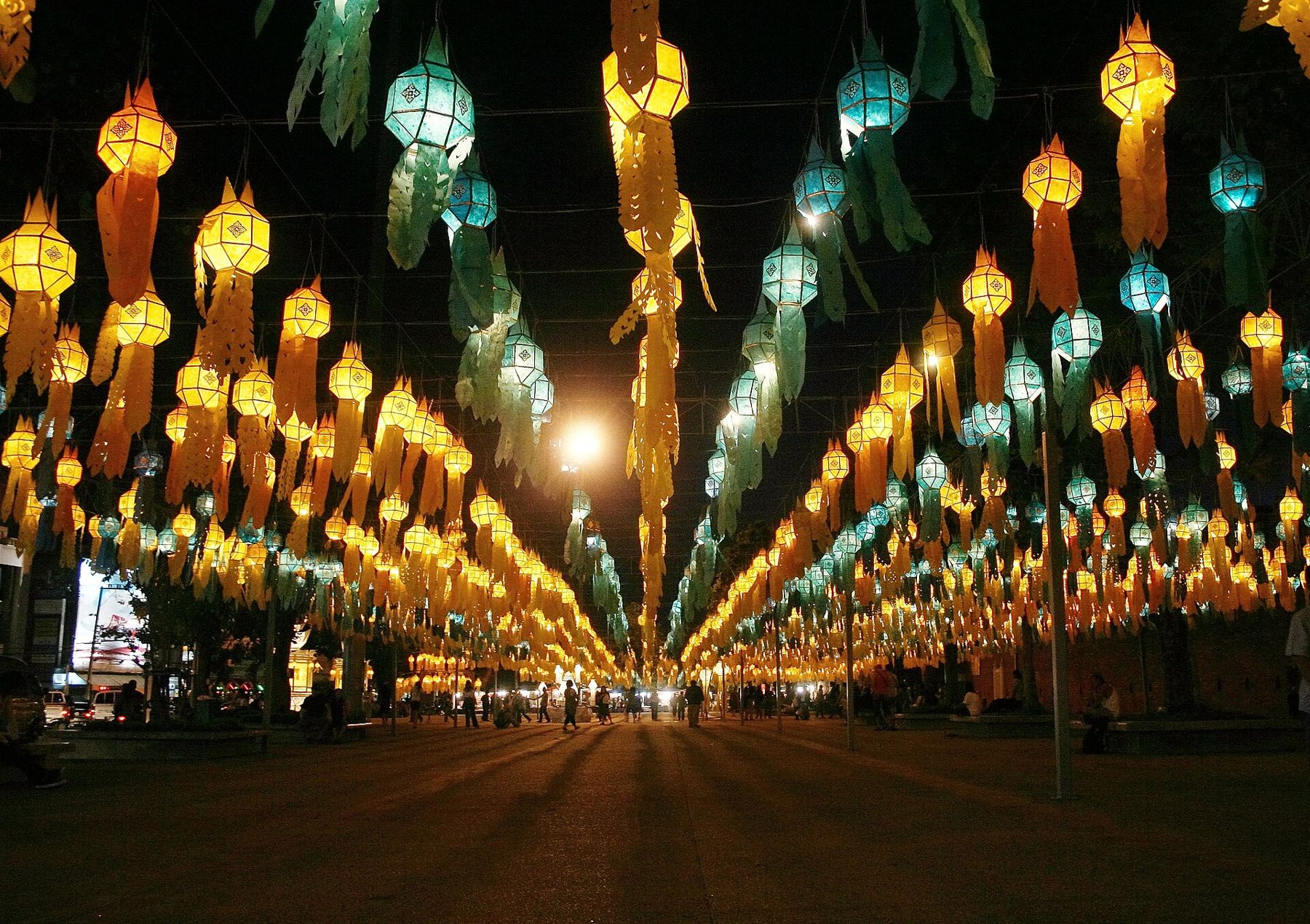
The cool season, from November to January, is the most comfortable time to visit. From February to April, smoke from forest and agricultural fires often fills the valley, making the air hazy and unhealthy; check air-quality readings before long walks. Songkran, the Thai new year in mid-April, turns the moat roads into a giant water fight. In November, the Yi Peng and Loy Krathong festivals bring lanterns and candles to the river and temples. For another old city walk in Thailand, see Phuket Town or Bangkok's royal island. Opening hours change, so check them for Chiang Mai before you go.