Intramuros means within the walls. When the Spanish founded Manila in 1571, they built their city on the south bank of the Pasig River where it meets Manila Bay, and over the following century they surrounded it with thick stone walls, bastions and a moat. Inside stood churches, convents, schools, government buildings and the houses of the Spanish elite; outside lived everyone else. For three centuries, Intramuros was the seat of Spanish power in Asia.
In February 1945, during the Battle of Manila at the end of the Second World War, most of Intramuros was destroyed. Fighting and bombardment flattened churches, houses and public buildings, and many civilians were killed. Of the great churches inside the walls, only San Agustin survived largely intact. In the decades since, parts of the walled city have been restored or rebuilt, and today the walls themselves are among its most impressive features.
San Agustin Church and its cloister
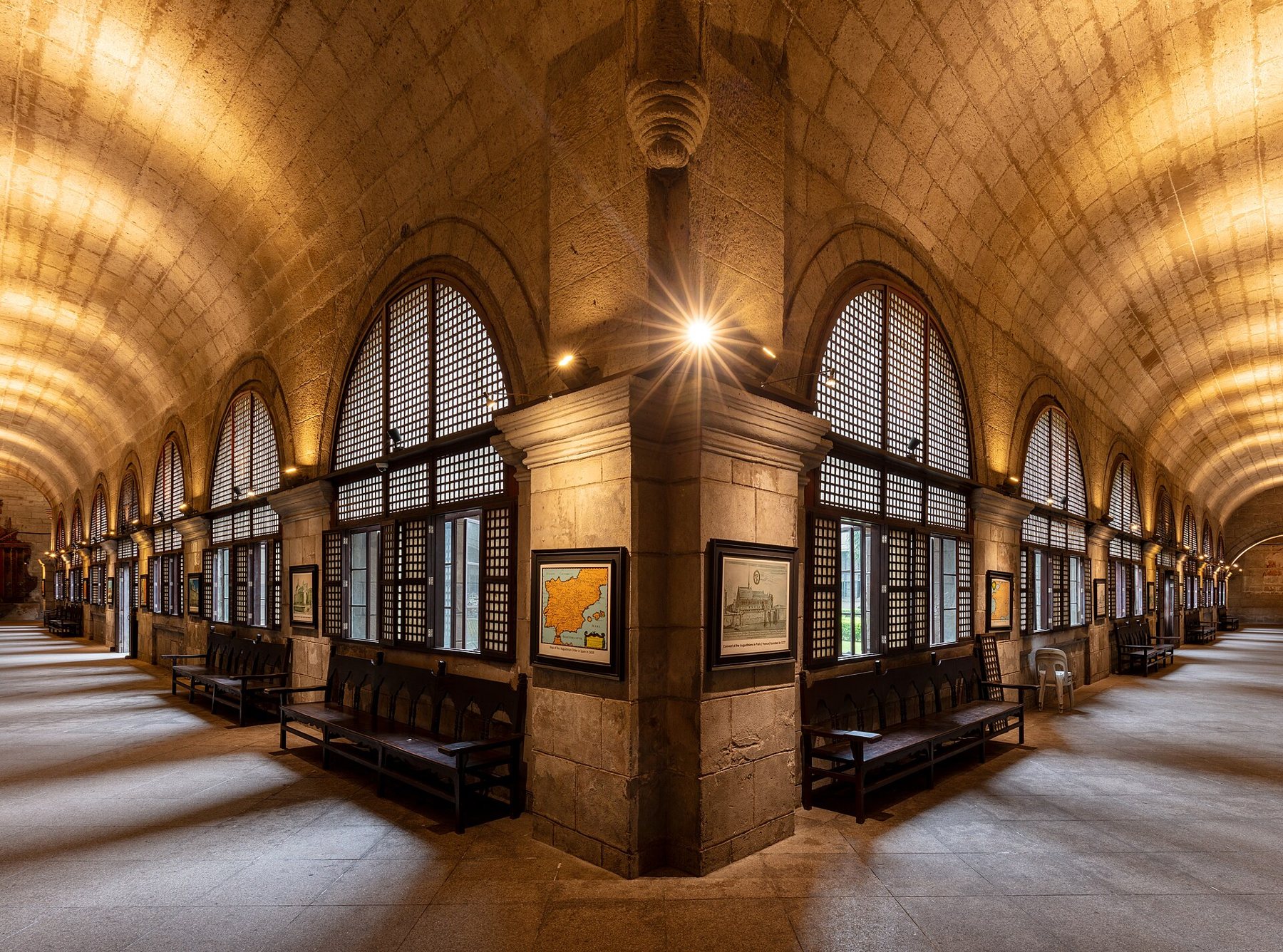
San Agustin Church, completed in the early seventeenth century, is the oldest stone church in the Philippines. Its plain facade hides a richly decorated interior, with painted ceilings that create the illusion of carved stone, a carved pulpit and a choir loft with old wooden stalls. It has survived earthquakes as well as the war, and it is one of four Baroque churches in the Philippines listed together as a UNESCO World Heritage Site.
The adjoining monastery is now a museum, arranged around a quiet cloister garden. Its rooms hold religious art, vestments, old books and furniture, and the long corridors give a sense of the scale of the religious orders that once dominated the city. A visit to the church and museum takes about an hour. Weddings are often held in the church, especially at weekends, and visitors may be asked to wait or keep to the back during ceremonies. The plaza in front of the church, with its stone lions, is one of the few corners of Intramuros that still looks much as it did before the war.
Manila Cathedral and Plaza de Roma
A few blocks north, Manila Cathedral faces Plaza de Roma, the old main square of the walled city. The cathedral has been destroyed and rebuilt several times, by fire, earthquake and war; the present building, with its green dome and bell tower, dates from the 1950s and has since been strengthened against earthquakes. Its interior is light and calm, with stained-glass windows and a large pipe organ.
The plaza is surrounded by government buildings, some of them restored or rebuilt in the old style. It is a good place to pause in the shade of the trees before continuing north. The cathedral is a working church with frequent masses and weddings, so time a visit between services if you want to look around inside without disturbing worshippers.
Fort Santiago by the river
At the northern tip of Intramuros, where the walls meet the Pasig River, stands Fort Santiago. Built by the Spanish in the late sixteenth century on the site of an earlier fortification, it guarded the river mouth and served as a military headquarters and prison. Its stone gate, carved with the figure of St James on horseback, is one of the most recognisable sights in Manila.
Fold over to B5Binondo and Escolta, across the PasigInside the fort are gardens, ruins and a shrine to José Rizal, the national hero of the Philippines, who was imprisoned here before his execution in 1896. Bronze footprints set into the ground trace his last walk from his cell to the place of execution. The fort has a separate entry fee, and a visit takes about an hour.
Up on the ramparts
The walls of Intramuros run for roughly four and a half kilometres, and much of the circuit can be walked on top, along the ramparts and bastions. Access points are spread around the walled city, and some sections may be closed for restoration or events, so check locally before setting out.
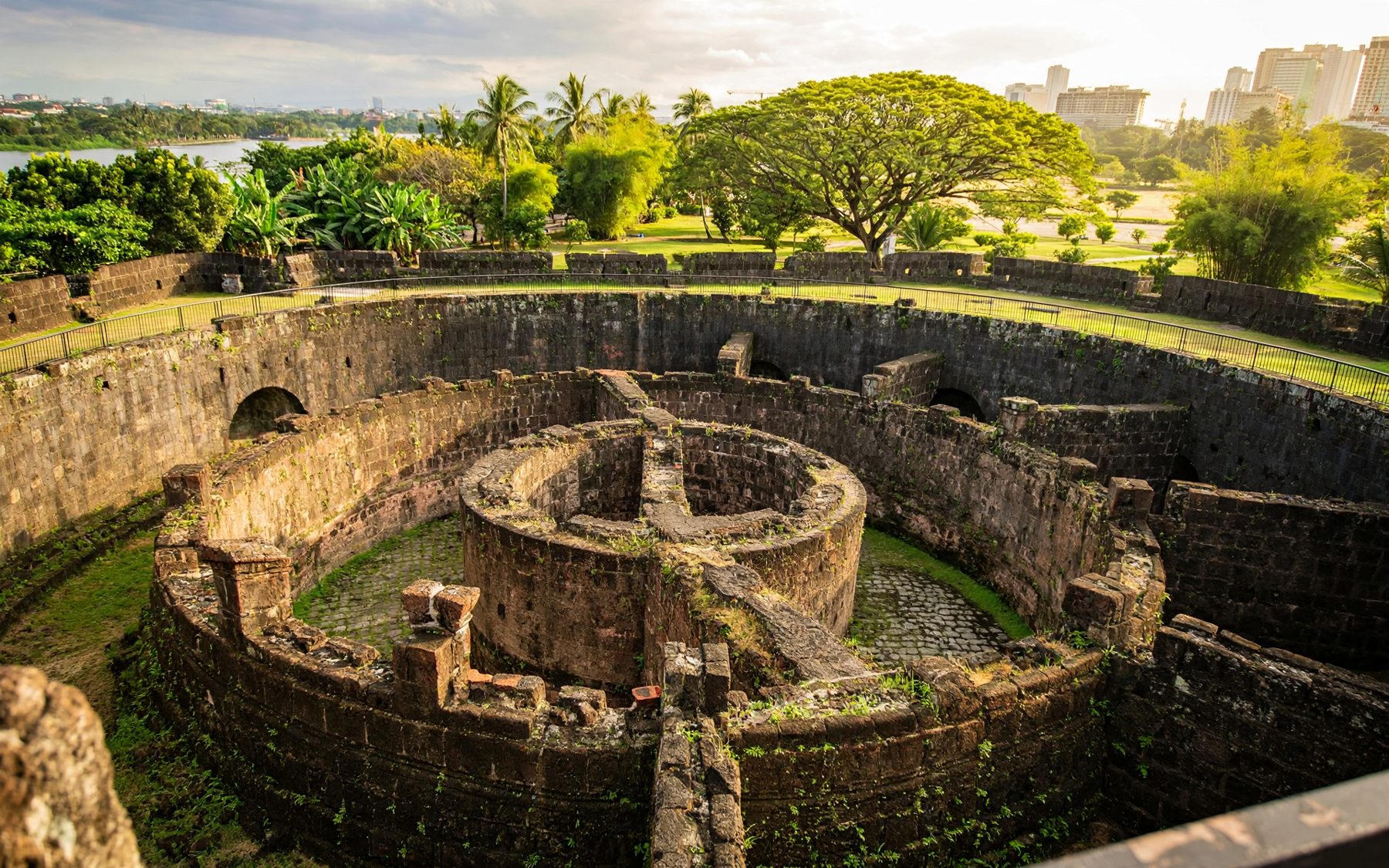
The walk along the top gives a completely different view of the city: on one side, the restored streets and churches of Intramuros; on the other, the modern skyline of Manila, the old moat now filled with green spaces, and the busy roads outside. The round Baluarte de San Diego in the south-western corner, one of the oldest stone fortifications in the city, has been restored with gardens and is a good place to start or finish.
The walls are easiest to follow in a loop. Climb up near Fort Santiago, walk south along the western ramparts, and drop down at Baluarte de San Diego, the round bastion at the southern corner with its quiet gardens. The surface is uneven in places and there is little shade, so carry water, wear a hat and avoid the hours around noon. Benches and small cafes inside the walls make good stops along the way.
The late afternoon is the best time, when the heat begins to ease and the setting sun lights the stone walls a warm gold. The western walls face Manila Bay, famous for its sunsets.
Houses, carriages and the restored streets
Between the major sites, the streets of Intramuros are lined with restored and rebuilt houses, schools and offices. Some are reconstructions of the old two-storey houses typical of the Spanish period, with stone lower floors and wooden upper floors with sliding windows of translucent shell. One of these, a reconstructed nineteenth-century house, is open as a museum furnished with period pieces.
Horse-drawn carriages called kalesas wait near the main sites and offer rides around the walled city. Agree on the price and the route before you set off, as fares vary. General Luna Street, running through the heart of Intramuros past San Agustin, is one of the main routes and a good spine for exploring on foot.
The late afternoon is the best time, when the heat begins to ease and the setting sun lights the stone walls a warm gold.
Trains to the confluence
Intramuros is a short walk from the Central Terminal station on the LRT Line 1, and a taxi or ride from most parts of Manila. Visit the churches and museums in the morning, take a long break in the hottest hours and climb onto the walls in the late afternoon. The rainy season, roughly June to October, brings heavy downpours and occasional typhoons; the dry months from December to April are the most comfortable. Mass times, museum hours and access to the walls change, so check them for Manila before you go.
From Fort Santiago, the Pasig River separates Intramuros from Binondo, the old Chinese district, just across the bridges to the north. Binondo and Escolta make a natural second half to the day. For another walled-city atmosphere in the Philippines, go north to Vigan.