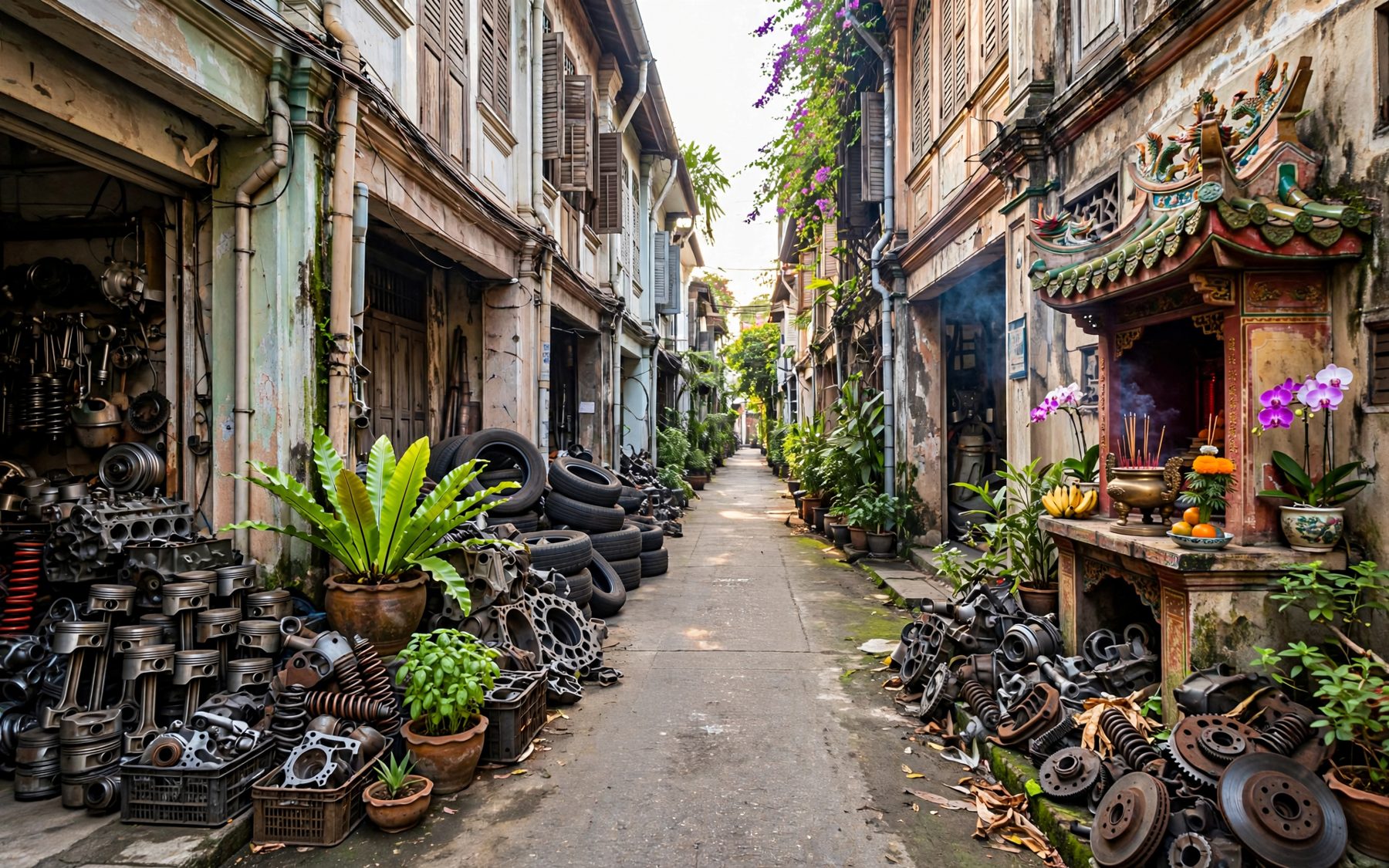
Talat Noi means little market in Thai. It is one of the oldest neighbourhoods in Bangkok, a riverside quarter just south of Yaowarat, the main street of Chinatown, settled by Chinese traders and labourers from the late eighteenth century onwards. Its lanes are narrow and winding, too small for cars, and they hold a mixture of old houses, shrines, workshops and homes that has changed slowly while the city around it has transformed.
What makes Talat Noi unusual is its trade. For decades it has been a centre for second-hand engine and machinery parts, and many of its lanes are piled high with pistons, gearboxes, cylinder heads and rusty metal of every kind, stacked outside workshops and spilling onto the paths.
Into the lanes
The neighbourhood begins a short walk from the river and from Chinatown. There is no single entrance: turn off the main road into one of the small lanes, and the city noise drops away. The lanes twist between buildings, sometimes no wider than a doorway, and open unexpectedly into small courtyards and shrines.
Walking here is a matter of wandering. The area is small, and you will come out on the river or a main road whichever way you go. Watch out for motorbikes, which use the narrow lanes too, and for the stacks of heavy metal parts along the edges. Wear closed shoes rather than sandals: the paths are often oily and uneven.
The engine-parts trade
The workshops of Talat Noi sell and repair used engine parts, many of them salvaged from old cars and trucks. Mechanics work in small open-fronted spaces, surrounded by their stock, and the smell of oil fills the air. It is a working area, not a museum. Be careful not to get in the way, and ask before taking photographs of people at work.
The piles of rusting metal have become an attraction in their own right, especially for photographers, and murals have been painted on some of the walls in recent years. The trade itself is shrinking, though, and some workshops have given way to cafes and galleries.
A Hokkien courtyard house
Facing the river at the edge of the neighbourhood stands a large Chinese courtyard mansion, built in the Hokkien style around two hundred years ago by a wealthy merchant family. Its long, low buildings surround a courtyard, with carved wooden doors and a roof decorated in the southern Chinese manner. It is privately owned, and whether visitors are admitted varies; respect the owners' privacy and look from outside if it is closed.
The mansion is a reminder of the wealth that once flowed through this riverside trading district, when goods from China and the rest of Asia were unloaded at the piers nearby.
Holy Rosary Church
Fold over to C3Rattanakosin island, temple to templeAt the northern edge of Talat Noi, close to the river, stands the Holy Rosary Church, one of the oldest Catholic churches in Bangkok. It was founded by Portuguese Catholics in the late eighteenth century, and the present building, in a Gothic Revival style with a tall spire and stained-glass windows, dates from the late nineteenth century. The church still serves a local congregation. Visitors are welcome outside service times; dress modestly and keep quiet inside.
Shrines and festivals
Small Chinese shrines are scattered through the neighbourhood, some in the open air, some inside old buildings. Incense smoke drifts from them, and offerings of fruit and flowers are left on their altars. During Chinese New Year and the vegetarian festival, the neighbourhood is decorated with lanterns and flags, and the shrines are busy with worshippers.
Respect these places: do not climb on altars or touch offerings, and ask before photographing people at prayer.
The lanes are narrow and working vehicles use them, so walk to the side and listen for motorbikes behind you. Many of the houses are homes as well as workshops; keep your voice low and ask before photographing anyone.
The river edge
Talat Noi faces the Chao Phraya, and several of its lanes end at small piers and landing stages. From here, the view across the river takes in the Thonburi bank, with its temples and warehouses, and the steady traffic of river boats, barges and ferries. A riverside walkway runs along part of the waterfront, a quiet place to sit in the evening breeze.
The river was the reason the neighbourhood existed. Goods arrived by boat from upriver and from overseas, and the warehouses and trading houses along the bank handled rice, timber and imported goods. Some of the old warehouses survive, converted to other uses; others have been replaced by newer buildings, and parts of the riverfront are changing fast.
Chinatown next door
From Talat Noi, it is a short walk north to Yaowarat, the main road of Bangkok's Chinatown. By day, it is a busy commercial street, with gold shops, wholesale markets and traffic. In the evening, food stalls set up along the pavements, and the street is lit by neon signs in Chinese characters. The lanes off Yaowarat, such as Sampeng Lane, are packed with wholesale stalls selling everything from fabrics to toys.
From Chinatown, the MRT station at the old Hua Lamphong railway station connects with the rest of the city, and the river boats stop at piers nearby. Head upstream by boat to Rattanakosin for the royal temples, or go north to Chiang Mai for a very different old city. Workshop hours and access to private buildings vary, so ask at the door before you plan around them.